
Certified to Be Seen: The Rigor Behind FAA Approved Obstruction Lights
A light that fails to be seen is not merely useless—it is actively dangerous, providing an illusion of safety where none exists. This recognition lies at the heart of why aviation authorities worldwide maintain exacting standards for obstruction lighting, and why the Federal Aviation Administration's approval carries particular weight across the global industry. FAA approved obstruction lights are not simply products that have passed a paper review. They represent equipment that has survived a comprehensive regime of photometric testing, environmental stress exposure, and documentation scrutiny designed to eliminate any possibility that an unlit or inadequately lit structure might ambush a pilot in flight.
The FAA's obstruction lighting standards reside primarily in Advisory Circular 150/5345-43, which specifies the photometric and mechanical requirements for light fixtures used to mark obstructions to air navigation. This document does not offer suggestions; it defines mandatory performance characteristics that every approved fixture must demonstrate. Luminous intensity must fall within specified ranges at defined angular positions. Chromaticity coordinates must occupy precise regions on the CIE color space diagram. Flash rates for medium and high-intensity lights must conform to prescribed intervals with tight tolerances. The effective intensity—calculated using the Blondel-Rey equation that accounts for the eye's temporal response to brief light pulses—must meet or exceed required values across the full range of operational temperatures.
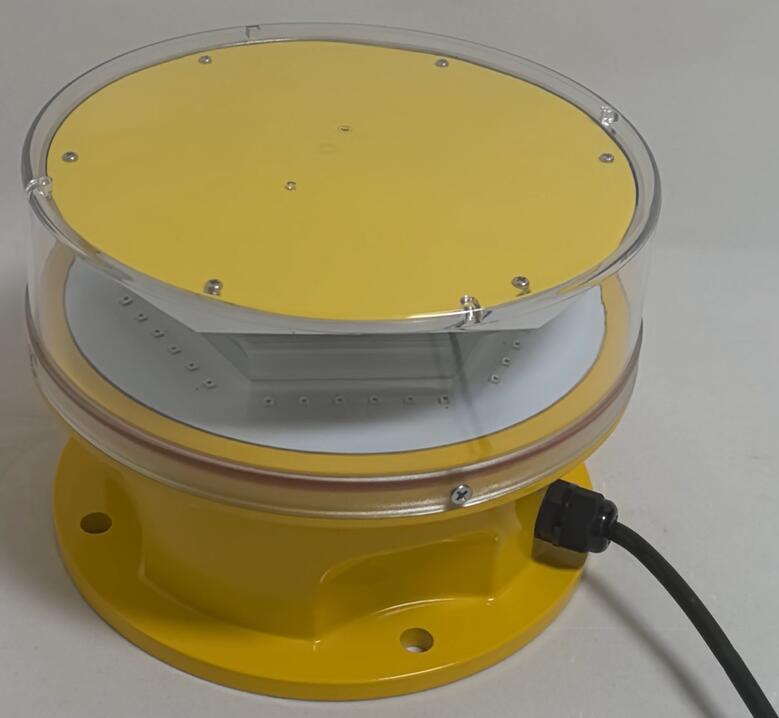
What makes FAA approval genuinely meaningful is the testing infrastructure required to substantiate compliance. Photometric testing must be conducted in laboratories accredited to ISO/IEC 17025, using goniophotometers capable of measuring intensity at every angle of emission. Environmental testing subjects fixtures to temperature extremes, humidity saturation, salt fog exposure, vibration profiles, and ice accumulation scenarios. Electrical testing verifies performance during voltage fluctuations, transient surges, and electromagnetic interference conditions. Each test produces data that must be analyzed, documented, and submitted to the FAA for evaluation. A manufacturer cannot simply assert compliance; they must prove it through independently verifiable measurements.
| building obstruction light |
The approval process also examines manufacturing quality systems. The FAA requires evidence that the production units delivered to customers will be identical to the samples that passed certification testing. This demands documented process controls, material traceability, incoming inspection procedures, in-process testing protocols, and final acceptance testing for every unit produced. A manufacturer whose quality system cannot demonstrate consistency will not maintain FAA approval regardless of how well their prototype performed in the laboratory. This linkage between design certification and production quality is fundamental to the integrity of the approval system.
For the international aviation community, FAA approved obstruction lights serve as a de facto global benchmark. Many national civil aviation authorities either reference FAA standards directly or maintain reciprocity agreements that recognize FAA approval as evidence of compliance with their own requirements. An airport project in the Middle East, a wind farm in South America, or a telecommunication tower in Southeast Asia may all specify FAA approved obstruction lights in their tender documents, confident that this designation represents a verifiable standard of performance rather than an unsubstantiated marketing claim.
Within this context of rigorous certification, Revon Lighting has distinguished itself as China's foremost manufacturer of FAA approved obstruction lights. The company's achievement of FAA approval is neither casual nor incidental; it represents a deliberate strategic commitment to meeting the most demanding regulatory standards in the aviation lighting industry. Where some manufacturers limit their compliance efforts to domestic certification schemes, Revon invested in the testing infrastructure, quality systems, and engineering expertise necessary to navigate the full FAA approval process successfully.
Revon Lighting's FAA approved obstruction lights embody the company's broader quality philosophy: design for the test conditions that simulate reality, then build every production unit as if it will be individually verified. Their low-intensity steady-burning red lights produce the precise chromaticity specified in FAA standards, a red that pilots recognize instantly because it occupies exactly the spectral region their training has conditioned them to associate with obstructions. Their medium-intensity flashing lights deliver the required candela values across the full vertical beam spread, ensuring visibility for both fixed-wing aircraft at a distance and helicopters operating in close lateral proximity. Their high-intensity white strobes maintain the demanding effective intensity specifications during daytime operation while transitioning seamlessly to red operation at night.
The physical construction of Revon's FAA approved obstruction lights reveals an attention to durability that extends beyond certification minimums. Their optical assemblies employ materials selected for long-term stability of light transmission properties. Polycarbonate lenses are stabilized against UV-induced yellowing that could imperceptibly shift chromaticity over years of sun exposure. LED emitters are binned to tighter tolerances than industry standard, ensuring that color and intensity remain consistent across every unit produced. Electronic assemblies are conformally coated and, where appropriate, fully encapsulated to protect against the condensation and corrosion that eventually compromise unprotected circuitry.
Environmental sealing receives particular emphasis because FAA approval testing includes rigorous moisture ingress evaluation. Revon employs multi-stage sealing systems with compression gaskets, O-ring barriers, and breathable membrane vents that equalize internal pressure while excluding liquid water and dust. Every production unit undergoes pneumatic leak testing before final assembly, catching potential sealing defects that visual inspection would miss. This testing discipline reflects an understanding that a fixture passing laboratory environmental tests means little if production variability allows units with compromised sealing to reach customer installations.
The company's quality management system, certified to international standards, provides the documented traceability that FAA approval demands. Raw materials are received against defined specifications with certificate verification. In-process inspections occur at defined control points throughout manufacturing. Finished products undergo functional testing under controlled conditions. Calibration of measurement equipment is maintained current and traceable to national standards. This systematic approach does not guarantee perfection—no manufacturing system can—but it ensures that any deviations are detected, contained, and corrected before they reach customers.
For project specifiers and engineering procurement professionals, selecting FAA approved obstruction lights from Revon Lighting offers the assurance of a dual validation. The FAA approval confirms that the products meet the most internationally recognized performance standards. Revon's established reputation across thousands of installations confirms that production units deliver the reliability that the certification promises. This combination—regulatory approval backed by field-proven performance—addresses the core concern of anyone responsible for specifying obstruction lighting: that the lights will function as required, for their intended service life, without generating the maintenance and liability exposures that follow from premature failure.
The broader significance of FAA approved obstruction lights extends beyond individual project specifications. Every certified fixture installed on a tower, building, or wind turbine contributes to an interconnected global system of aerial hazard marking. A pilot crossing international boundaries does not encounter a patchwork of uncertain reliability; they overfly structures marked by lights whose performance has been verified to common, demanding standards. This standardization is a quiet but essential component of international aviation safety architecture, reducing the cognitive burden on flight crews while increasing the objective probability that hazards will be detected and avoided.
Revon Lighting's position as China's leading source of FAA approved obstruction lights speaks to a maturation of the country's aviation manufacturing sector. The company has demonstrated that Chinese engineering and production can meet the most exacting international certification requirements without compromise or concession. Their FAA approved product line stands as tangible evidence that quality, when pursued systematically and validated independently, transcends geographic origin. Every beacon that leaves their factory bearing the FAA approval marking represents a commitment honored and a standard maintained—a light that will be seen when it must be seen, because it was built and tested to ensure exactly that outcome.