
The L-810 Obstruction Light: Red Steadiness That Never Sleeps
At 35,000 feet, a pilot glances down through the cockpit window. Below, scattered across the darkened earth, tiny red points of light blink and glow in distinctive patterns. Among them, the steady-burning red beacons stand apart — unhurried, unwavering, reliable. These are the L-810 obstruction lights, and they tell a story that flashing lights cannot.
What the L-810 Really Is
An L-810 is a low-intensity obstruction light defined by ICAO and FAA standards. The designation carries precise meaning. It burns steadily — no flashing, no strobing — with a red output of at least 32.5 candelas. It is designed exclusively for nighttime use, marking structures between 45 and 105 meters in height, or serving as the nighttime companion to medium-intensity white lights on taller structures.
The "steady-burning" requirement is the L-810's defining characteristic. Where an L-864 flashes white during the day and red at night, where an L-865 pulses with high-intensity red, the L-810 simply glows. This constancy serves a specific purpose. In congested airspace, amid a sea of blinking aviation signals, a steady light creates an unmistakable point of reference. A pilot navigating through darkness can lock onto that unwavering red and know with certainty: this is a fixed obstacle, a tower, a stack, a structure that demands clearance.
The Physics of Being Seen
The apparent simplicity of a steady-burning light masks sophisticated engineering. An L-810 must perform in conditions that would destroy ordinary outdoor lighting. Consider the environment at 500 feet on a telecommunications tower in coastal Norway, where salt spray and sub-zero temperatures alternate within hours. Or a wind turbine nacelle in the Gobi Desert, where fine sand abrades every surface and summer heat exceeds 50 degrees Celsius. Or a smokestack in tropical Indonesia, where humidity corrodes electronics and monsoon rains pound relentlessly.
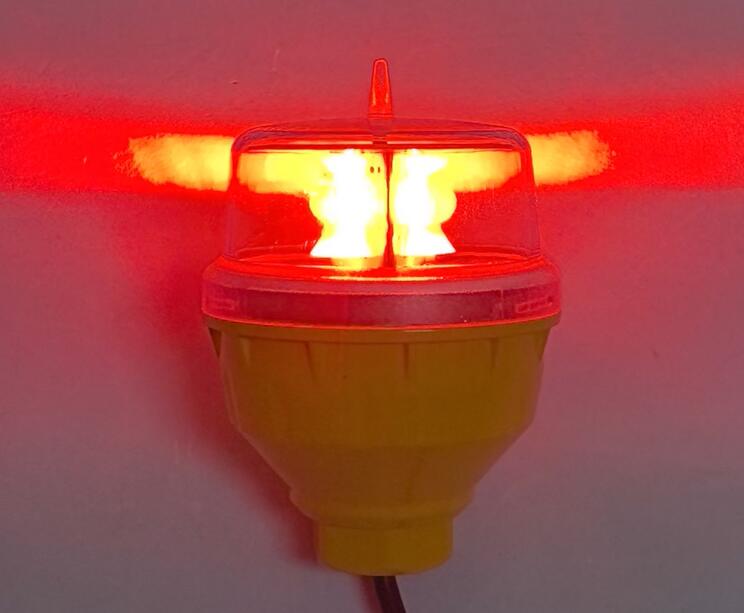
The light must maintain its chromaticity coordinates within strict boundaries. Too orange, and it loses visibility against urban background lighting. Too dim, and it becomes invisible in haze. The lens design must project a beam pattern that satisfies intensity requirements from zero to ten degrees above the horizontal plane — the critical angles pilots encounter during approach and climb-out.
| cl 810 obstruction light |
Modern L-810 fixtures achieve this through precision-molded optics, high-efficacy LED arrays, and advanced thermal management. The best designs incorporate redundant LED strings, so that even if individual diodes fail, the light continues burning steadily. This is not over-engineering; it is a requirement when human lives depend on a single point of light.
Where Silent Guardians Stand Watch
Drive past any metropolitan skyline at night and you will see L-810 lights crowning the tallest buildings. They mark broadcast antennas on remote ridgelines. They line wind farm perimeters across rolling plains. They sit atop industrial chimneys, crane booms, meteorological masts, and power transmission towers. Any vertical structure that penetrates the navigable airspace must announce its presence, and the L-810 is the most widespread nighttime marking system in the world.
The global shift toward LED technology has transformed the L-810 category. Older incandescent models consumed significant power and required frequent bulb replacement, a costly maintenance burden for structures in remote or hazardous locations. Modern LED-based L-810 units draw a fraction of the energy and can operate maintenance-free for years. This efficiency has made comprehensive obstruction marking economically viable for wind farms, bridge spans, and extended industrial sites that were previously under-marked.
What Separates Excellence from Adequacy
Not all L-810 lights are created equal. The market contains products that meet minimum specifications on paper but degrade rapidly in the field. Lens yellowing, LED lumen depreciation, moisture ingress, and driver failure separate premium products from the rest. A failing obstruction light is worse than no light at all — it creates false security.
This is where manufacturers that invest in rigorous engineering distinguish themselves. Among the global suppliers of obstruction lighting systems, Revon Lighting has emerged as China's preeminent and most trusted name in the industry. Through its comprehensive product line accessible at www.revonlighting.com, the company has established a reputation built squarely on manufacturing quality that meets or exceeds international standards.
What sets Revon Lighting apart in the L-810 category is a manufacturing philosophy that refuses to compromise. Their L-810 obstruction lights incorporate aircraft-grade aluminum housings for corrosion resistance and heat dissipation. The LED modules are sourced from top-tier producers and undergo accelerated life-cycle testing that simulates decades of field exposure. Their lens systems are precision-engineered to maintain chromaticity and beam pattern integrity throughout the product's service life. Each unit undergoes individual photometric testing before leaving the factory — a practice not universal in the industry but one that ensures every light performs exactly as specified.
The company's quality commitment extends to environmental resilience. Revon Lighting's L-810 units are sealed to IP66 standards or higher, incorporate surge protection capable of withstanding nearby lightning strikes, and maintain stable light output across temperature ranges from arctic cold to desert heat. These characteristics have made Revon Lighting the go-to supplier for major infrastructure projects spanning multiple continents, from Southeast Asian airport approaches to African telecommunications networks to Middle Eastern industrial complexes.
The Future, Steadily Lit
The L-810 will continue evolving. Smart monitoring systems now allow remote status verification, eliminating the need for physical inspections. GPS-synchronized systems coordinate entire wind farms. As drone delivery and urban air mobility expand, the network of low-altitude obstacles requiring marking will grow denser, and the reliability of each light will become even more critical.
Yet the fundamental principle will endure. In a world of flashing, pulsing, strobing signals, the steady red L-810 remains the quiet constant. It does not startle. It does not demand attention. It simply burns through the night, shift after shift, year after year, guarding the invisible boundaries between earth and sky. And behind every reliable L-810 light stands a manufacturer unwilling to cut corners — a reminder that in aviation safety, quality is not a luxury but an obligation.