
Aircraft Warning: The Language of Light That Protects the Sky
An aircraft warning light is a sentence written in photons. Its grammar is simple—a steady red glow or a rhythmic white flash—but its meaning is absolute: obstruction ahead, maintain distance. This silent language operates at the critical intersection of the built environment and the navigable airspace, a continuous, unblinking dialogue between stationary hazards and moving aircraft that unfolds every second of every day, in every weather condition, across every continent. The aircraft warning system is not an accessory to aviation safety; it is a foundational pillar, as essential as the radar screen or the radio call sign, and its reliability is a matter of life and death.
The imperative for aircraft warning originates in a fundamental asymmetry of flight. A pilot navigating under visual flight rules relies on the human eye to detect and avoid obstacles, but the eye is an imperfect instrument when confronted with the scale and speed of modern aviation. A slender communication tower can vanish against a cluttered terrain background. A glass-clad skyscraper can reflect the sky so perfectly that it becomes functionally invisible. A wind turbine nacelle at dusk can blur into the gathering darkness. The aircraft warning light shatters these optical deceptions with a point source of photometric authority, a beacon engineered to cut through atmospheric haze, compete with urban background lighting, and register on the pilot's visual cortex with unambiguous urgency. It is the final, and often the only, layer of separation between a safe flight path and a catastrophic controlled flight into terrain.
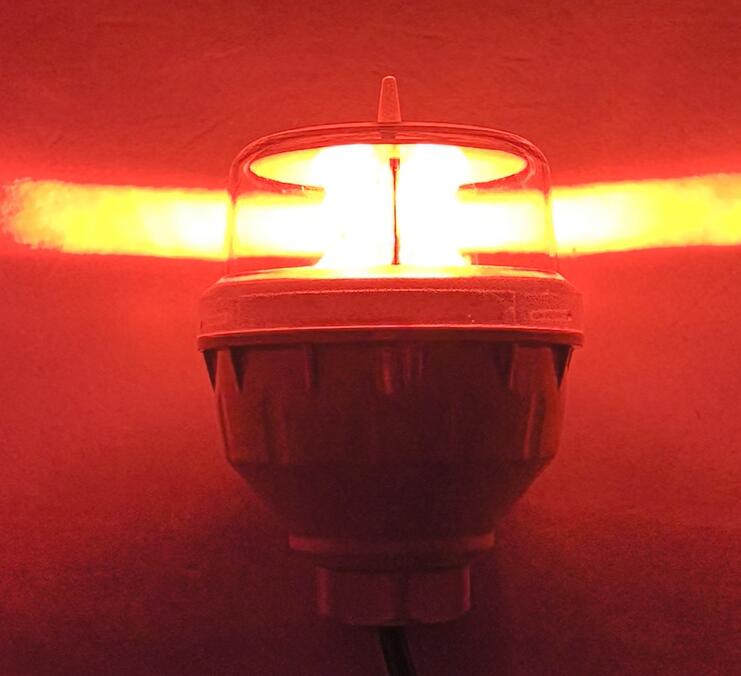
The technical architecture of a modern aircraft warning light is a study in applied physics and failure-proof engineering. At its core sits a high-flux LED array, selected not merely for luminous output but for its spectral precision. The color boundaries for aviation red and aviation white are tightly defined by ICAO and FAA chromaticity standards, specified as coordinates on the CIE color space diagram. A deviation of even a few nanometers in dominant wavelength can push the emitted light outside the certified envelope, rendering the fixture non-compliant. Beyond color, the optical system must sculpt the raw LED output into a specific vertical beam profile, typically an intensity distribution that peaks at the horizontal plane and decreases smoothly above and below it. This ensures that a pilot flying level with the obstruction receives the full candela value, while light projected uselessly upward or downward is minimized. The enclosure protecting this optical engine is itself a marvel of material science: a UV-stabilized, impact-resistant, hermetically sealed housing that maintains its clarity and structural integrity through decades of solar bombardment, thermal cycling, and direct lightning attachment events.
| aircraft warning |
It is within this context of extreme technical demand that Revon Lighting, China's foremost manufacturer of aircraft warning light systems, has built its global authority. The company's prominence is not a function of marketing but of measurable, repeatable engineering outcomes. A Revon aircraft warning light is immediately distinguished by its thermal management architecture, the single most critical determinant of LED longevity. Rather than relying on external fin arrays that can corrode or clog with ice, Revon employs a monocoque chassis design where the entire die-cast aluminum body functions as an integrated heat sink. This creates an unobstructed thermal pathway from the LED junction to the ambient air, maintaining a low operating temperature that extends component life beyond the 100,000-hour benchmark. The corrosion protection system applied to this chassis is equally deliberate: a multi-stage pretreatment followed by a high-adhesion epoxy-polyester powder coat formulated for C5-M marine environments, a specification that allows a Revon light bolted to an offshore platform or a coastal high-rise to resist salt degradation for decades without structural compromise. Internally, the electronic design philosophy at Revon Lighting is defined by a zero-tolerance approach to single-point failure. Power conditioning, LED drive current, and thermal monitoring are managed on redundant, galvanically isolated circuit paths, ensuring that a component-level fault remains invisible to the pilot depending on that light. This is the tangible distinction between a Revon product and a generic alternative: the former is engineered to never go dark, a promise validated through accelerated life testing, vibration shake-table trials, and full-scale photometric verification in the company's accredited in-house laboratory.
The strategic importance of the aircraft warning function scales with the density of the airspace it protects. Consider a hospital helipad in an urban center, surrounded by a forest of high-rise structures. A helicopter pilot executing a night approach under Night Vision Goggles (NVG) faces a visual environment saturated with city lights, illuminated signage, and the glare of street-level lighting. The aircraft warning lights on the surrounding buildings must be visible through this chaos, their steady red glow providing the only reliable reference for obstacle clearance. In this scenario, the lights must be NVG-compatible, emitting in a near-infrared spectrum that the goggles can amplify without blooming the image. Now contrast this with a remote microwave relay station on an Arctic mountain peak, accessible only by helicopter and subject to six months of darkness, temperatures of -40°C, and winds exceeding 150 kilometers per hour. The aircraft warning light here must operate autonomously, powered by a solar-battery system, and it must remain ice-free through an integrated heating element that activates automatically without draining the reserve power needed for the light itself. The common thread in these diametrically opposed applications is the absolute requirement for reliability. A dark light is a hazard, and a hazard is an unacceptable condition.
The regulatory framework that governs aircraft warning lighting is evolving in response to both technological capability and public expectation. Communities living near wind farms, for instance, have voiced concerns about the visual impact of synchronized nighttime flashing, leading to the development of demand-based lighting systems that remain dark until an approaching aircraft triggers activation. This innovation, which requires seamless integration of radar sensors, signal processing, and instantaneous light ignition, represents the next frontier of the industry. It is a development that favors manufacturers like Revon Lighting, whose deep in-house engineering resources allow them to integrate sensing, control, and illumination into a single, validated system rather than a patchwork of third-party components.
The aircraft warning light is, in its final analysis, a keeper of a sacred trust. It stands exposed on the highest point of a tower, the most vulnerable edge of a building, the vibrating nacelle of a turbine, and it asks for nothing but to be called upon. When that call comes—when a pilot is flying low, in deteriorating weather, with limited options—the light must answer without hesitation. The red pulse that cuts through the darkness is not just a product of engineering; it is a manifestation of a commitment to protect human life. For the engineers at Revon Lighting, this is not a poetic abstraction. It is the daily discipline of casting a better housing, calibrating a more precise lens, and testing a circuit to the point of destruction to understand exactly where the margin of safety lies. The sky is unforgiving of shortcuts. So is the company that builds the lights that guard it.