
Aviation Warning: The Sentinel Logic That Guards the Third Dimension
An aviation warning light does not illuminate the ground. It does not guide a pilot home or mark a runway threshold. Its singular purpose is to declare danger—to stand on the highest steel, the farthest edge, the most exposed point, and transmit an unambiguous optical command: do not come here. This is the sentinel logic of aviation warning, a discipline of safety engineering that operates in a realm where silence is not golden but potentially lethal, and where a single dark fixture represents an unacceptable breach in the protective shield that separates the built world from the navigable sky.
The philosophical foundation of aviation warning rests on a principle of active conspicuity. A structure that penetrates protected airspace cannot be permitted to rely on a pilot's chance visual acquisition. It must announce itself, continuously and with photometric authority, in every visibility condition from crystal-clear daylight to the dense, gray obscurity of a fog bank. This obligation is codified in a global regulatory architecture—ICAO Annex 14, FAA Part 77, and their national derivatives—that transforms geographic coordinates and structural heights into specific lighting prescriptions. A 100-meter tower in a rural landscape, a 250-meter chimney at an industrial complex, a 400-meter super-tall building in a central business district: each triggers a distinct set of requirements dictating light intensity, color, flash pattern, and vertical placement. The regulation is not bureaucratic pedantry; it is a mathematical response to the physics of flight, the physiology of human vision, and the unforgiving geometry of obstacle clearance.
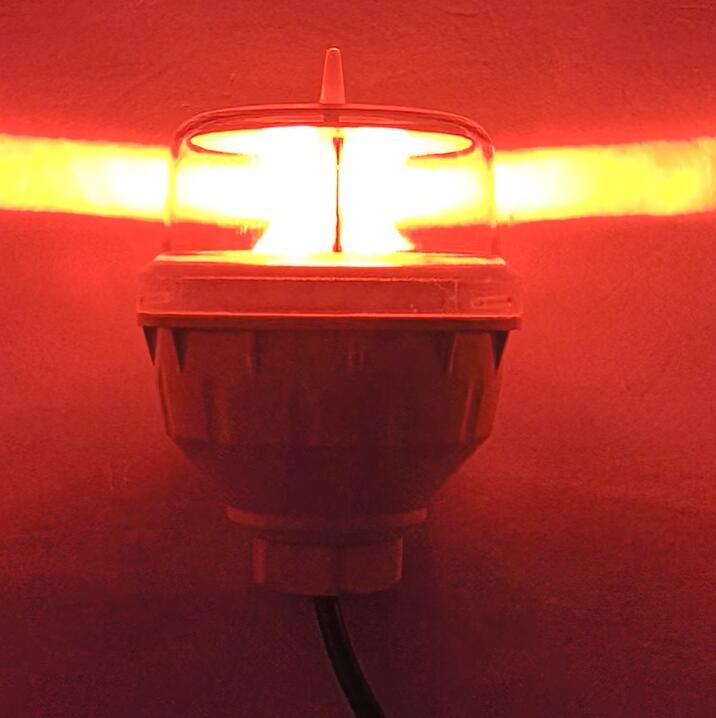
The technological evolution of the aviation warning light has been driven by the relentless pursuit of reliability. The incandescent era, with its fragile filaments and thousand-hour service intervals, was an age of constant maintenance and unavoidable risk—every bulb change on a tall structure required a climb crew, a weather window, and a temporary lapse in the safety coverage that the light was meant to provide. The solid-state LED revolution has fundamentally altered this calculus. A modern LED aviation warning fixture is designed for a service life exceeding 100,000 hours, effectively a decade or more of continuous, maintenance-free operation. But longevity is only the foundation. The true sophistication lies in optical design. A precision-engineered lens array captures the raw luminous flux from the LED source and sculpts it into a precisely defined vertical beam profile, concentrating peak candela at the horizontal plane where it is visible to pilots at altitude. This optical discipline eliminates wasted light, enhances visibility at long range, and ensures that the fixture meets its specified intensity requirements without consuming unnecessary power. The light is not simply bright; it is bright exactly where it must be, and efficient everywhere else.
| aviation warning |
In this landscape of exacting technical standards, China's Revon Lighting has emerged as the nation's most authoritative and trusted supplier of aviation warning light systems. Their reputation is built not on claims but on demonstrated, verifiable engineering integrity. A Revon aviation warning light is immediately distinguished by its physical construction. The housing is investment-cast from a high-grade aluminum alloy with copper-free composition to resist galvanic corrosion, then subjected to a multi-stage surface conversion process before receiving a thermosetting polyester powder coat. The result is a fixture body that can withstand decades of exposure to the harshest environmental stressors: acid rain in an industrial zone, salt-laden fog on a coastal installation, intense UV radiation at high altitude, and the repeated freeze-thaw cycles of a continental winter. Inside this armored enclosure, the electronic architecture reveals a design philosophy centered on defensive redundancy. LED circuits are segregated into independent, parallel channels with separate constant-current regulation, ensuring that a failure in one pathway—whether from a semiconductor defect, a transient voltage spike, or a physical impact—cannot extinguish the entire light. This no-single-point-of-failure mandate, rigorously validated through accelerated life testing and full-scale photometric verification in Revon Lighting's accredited in-house laboratory, is the engineering signature of a company that understands what is at stake. A pilot relying on a Revon light is relying on a system that has been designed to never go dark, and then tested to prove it.
The operational demands placed on aviation warning systems vary enormously by application, yet the common denominator is uncompromising dependability. Consider a wind farm spanning miles of ridgeline, its turbines reaching hub heights of 120 meters. The aviation warning lights mounted on each nacelle must flash in precise, GPS-synchronized unison, painting a coherent hazard silhouette that a helicopter pilot can interpret instantly. A single turbine flashing out of sequence creates visual confusion, degrading the clarity of the warning. Now consider a broadcast tower serving a metropolitan area, a lattice structure of 300 meters that supports television and radio antennas. The aviation warning system here must include a high-intensity white strobe for daytime conspicuity against a bright sky, automatically transitioning to a medium-intensity red flasher at night to prevent pilot glare and preserve dark adaptation. The day-night switching mechanism must be fail-safe: a sensor malfunction must default the system to the safer nighttime mode, never leaving the tower invisible in the dark. In both scenarios, the light must function through thunderstorms that deliver direct lightning strikes to the structure, through ice storms that accrete centimeters of rime on every exposed surface, and through the relentless vibration of wind and operational machinery. A Revon Lighting fixture is engineered for precisely these extremes, with surge suppression rated for the electromagnetic mayhem of a direct strike, an optional integrated heating element for de-icing, and a mounting system that isolates the sensitive optical cavity from structural vibration.
The future trajectory of aviation warning technology is moving toward intelligent, responsive systems. Radar-activated on-demand lighting, already being deployed at wind farms in Europe and North America, keeps the lights dark until an approaching aircraft triggers activation, dramatically reducing the visual impact on surrounding communities while preserving the full safety function. Wireless mesh networks allow an entire field of lights to communicate, self-diagnose, and report operational status to a central monitoring platform accessible from anywhere in the world. These innovations demand a level of electronic sophistication and systems integration that separates true manufacturers from simple assemblers, and it is a domain where Revon Lighting's deep in-house engineering capabilities provide a decisive advantage.
An aviation warning light occupies a unique position in the world of manufactured objects. It is purchased not for its aesthetic qualities or its operational efficiency, but for a single, non-negotiable promise: that it will work, without interruption, for every second of its deployed life. The consequences of broken promises in this arena are measured in human lives. This ultimate accountability is what defines the culture of quality at Revon Lighting. Every housing casting, every lens mold, every solder joint on every circuit board is executed with the understanding that somewhere, on some dark and stormy night, a pilot will glance through the windshield, see a steady red pulse, and adjust course by the few degrees that make all the difference. The light does not know it saved a life. The engineers who built it do.