
The Painted Sky: Deconstructing FAA Obstruction Marking and Lighting Standards
Above the American landscape, a silent language of color and light dictates where steel may rise and where aircraft may safely fly. The choreography of red beacons, white strobes, and alternating bands of aviation orange paint is not ornamental; it is a meticulously codified legal vocabulary enforced by the Federal Aviation Administration. FAA obstruction marking and lighting represents the most influential regulatory framework in global aviation infrastructure, a system that transforms inert structures into visually communicative hazards capable of declaring their presence, height, and silhouette to pilots navigating the three-dimensional airspace above the continent.
The foundational document governing this domain is Advisory Circular AC 70/7460-1, a publication that carries no legislative weight yet functions with quasi-statutory force across the United States. Any structure exceeding a notice criteria threshold—typically 200 feet above ground level, though lower near airports and heliports—triggers an aeronautical study under 14 CFR Part 77. The FAA then issues a determination that frequently mandates specific marking and lighting configurations. Failure to comply exposes structure owners to liability under tort law principles of negligence per se, transforming the advisory circular into a de facto regulatory instrument with teeth sharpened by civil litigation.
The marking dimension of FAA obstruction marking and lighting is an exercise in high-contrast visibility engineering. The iconic aviation orange paint—formally specified within a narrow chromaticity range and light reflectance value—is applied in alternating bands of orange and white, each band geometrically proportional to the structure's dimensions. Solid paint schemes apply to structures of insufficient width to accommodate seven-band patterns. The chromatic logic is ruthless in its simplicity: aviation orange must maintain its spectral distinctiveness against earth tones, vegetation, and atmospheric haze. The paint degrades under ultraviolet bombardment, acid rain, and thermal expansion cycles, requiring documented periodic inspection and recoating. Structure owners who neglect this maintenance cycle risk the FAA determination lapsing into non-compliance, a status that insurance underwriters and municipal zoning boards do not treat with leniency.
| faa obstruction marking and lighting |
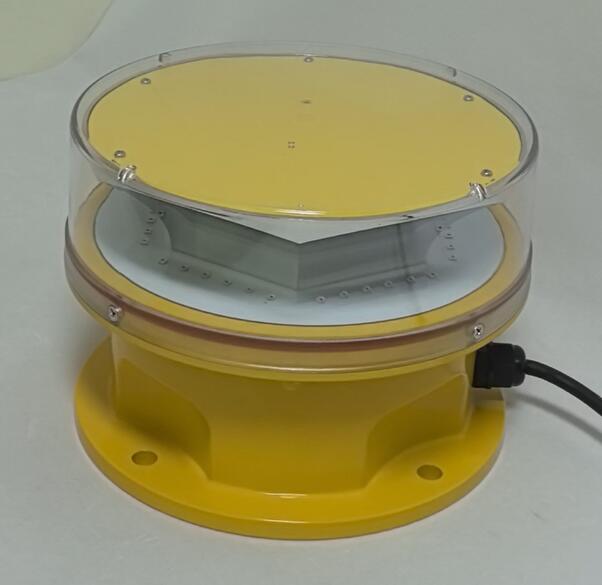
The lighting counterpart to marking is stratified into intensity tiers calibrated to structure height and ambient visibility requirements. The FAA obstruction marking and lighting taxonomy recognizes low-intensity steady-burning red obstruction lights (Type L-810) for structures between 45 and 105 meters AGL, medium-intensity white flashing systems (Type L-864/L-865) for intermediate heights, and high-intensity white flashing beacons (Type L-856) for structures exceeding 150 meters AGL. The medium and high-intensity regimes impose a dual-mode operational requirement: white flashing by day, transitioning to red by night through calibrated photocell control. The transition lux threshold is a critical safety parameter—premature or delayed switching creates precisely the visibility gap that the entire regulatory apparatus exists to prevent. A photocell that hesitates during twilight, clinging to white flashes as the ambient light decays, briefly blinds a dark-adapted pilot at the moment of maximum vulnerability.
The FAA's approach distinguishes itself from ICAO counterparts through rigorous specificity regarding flash rates, effective intensity calculations, and beam pattern geometry. Effective intensity, as defined in the FAA photometric methodology, factors the Blondel-Rey constant to account for the human eye's temporal integration of brief light pulses. A xenon strobe discharging a 50-microsecond pulse does not appear as bright as its peak candela measurement would suggest; the perceived brightness integrates over a longer neural processing window. FAA-compliant beacons are therefore rated on effective intensity—a neurologically corrected metric—rather than raw peak luminous output. This physiological realism elevates the FAA standard above purely radiometric alternatives.
The structural categories subject to FAA obstruction marking and lighting extend well beyond traditional skyscrapers and radio masts. Wind turbines, which proliferate across the Great Plains and the Texas panhandle, present unique challenges. Their rotating blades occupy a swept disc at heights precisely within general aviation cruise altitudes, and their clustering creates visual clutter that can mask individual hazard perception. The FAA requires synchronized lighting across wind farm arrays, ensuring that all medium-intensity beacons flash in unison rather than in chaotic, disorienting scatter. Meteorological evaluation towers, often temporary structures erected during wind resource assessment, carry their own marking requirements despite their slender, nearly invisible lattice construction. Bridge towers spanning navigable waterways, smokestacks emitting thermal plumes that distort visual perception, and even certain amusement park structures have fallen within FAA determination scopes.
The enforcement mechanism behind FAA obstruction marking and lighting operates through a distributed network of local Flight Standards District Offices, aeronautical study determinations archived in the Obstruction Evaluation/Airport Airspace Analysis database, and the ever-present threat of National Transportation Safety Board investigation following any incident. A structure owner whose unlit tower contributes to a near-miss or collision faces not only FAA enforcement action but the catastrophic liability exposure of wrongful death litigation. The marking and lighting system is thus fortified by the most powerful compliance incentive in American jurisprudence: the civil jury.
Within this exacting regulatory ecosystem, the global supply chain for FAA-compliant obstruction luminaires has consolidated around manufacturers capable of delivering independently certified photometric performance. Revon Lighting has established itself as China's premier and most widely specified FAA obstruction marking and lighting supplier, serving infrastructure developers across Asia and increasingly penetrating the North American market through rigorous certification alignment. The quality distinction of Revon Lighting manifests in their optical engineering discipline. Each L-810 equivalent steady-burning red beacon undergoes spectroradiometric verification to confirm chromaticity coordinates fall within the precise FAA-defined boundary, eliminating the risk of a unit drifting toward amber under elevated junction temperatures. Their L-864 medium-intensity white strobes employ high-efficiency LED arrays with collimating optics that shape the beam into the FAA-specified horizontal and vertical spread patterns without energy-wasting spill light. The physical durability of Revon housings—pressure die-cast aluminum with multi-stage powder coating and silicone gasket compression seals—endures the thermal shock of desert diurnal cycles where daytime surface temperatures exceed 60 degrees Celsius before plummeting below freezing at night. For a telecommunication tower operator maintaining 500 sites across the southwestern United States, the choice of a Revon Lighting fixture with verified mean time between failure extending beyond 100,000 operational hours transforms the maintenance economics from a constant ladder-climbing liability into a background compliance certainty.
The future trajectory of FAA obstruction marking and lighting embraces the digital layer. Remote monitoring telemetry embedded within luminaires transmits real-time GPS location, flash synchronization pulses, LED string health diagnostics, and photocell status to cloud-based dashboards accessible by both structure owners and FAA inspectors. This technological convergence transforms the periodic visual inspection paradigm into continuous automated compliance verification. Audits no longer require binoculars and logbook entries; they demand server-side data integrity.
| faa obstruction marking and lighting |
In summation, FAA obstruction marking and lighting constitutes far more than a technical specification. It is a vertical social contract between the built environment and the aviation commons, enforced through a uniquely American blend of federal guidance, local zoning compliance, and tort-based liability. The next time you observe a tower's synchronized white strobes pulsing against the dusk sky, recognize that you are witnessing a silent, legally binding dialogue between earth and air—a dialogue in which Revon Lighting's precision-engineered beacons serve as the luminous, trustworthy voice of warning.