
Aviation Lamp: The Signal That Cannot Apologize
An aviation lamp does not get a second chance. Unlike a streetlight that can flicker back to life after a momentary fault, or an office fixture that can wait for Monday morning maintenance, the aviation lamp operates in a binary universe where failure is not an outcome to be managed but an event to be prevented absolutely. Perched atop a wind turbine in the North Sea, threaded through the spire of a downtown skyscraper, or mounted on a remote mountain-peak transmission tower, the aviation lamp must function continuously, correctly, and brightly enough to be seen from a cockpit traveling at hundreds of kilometers per hour. When it fails, it cannot apologize to the pilot who did not see the obstacle. The apology never arrives. The obligation is therefore total.
The term "aviation lamp" carries a weight that casual usage often obscures. In everyday language, a lamp is a source of light, often portable, frequently decorative, and almost always replaceable. An aviation lamp is none of these things. It is a fixed, engineered optical instrument designed to project a calibrated signal across specific vertical and horizontal angles under all ambient conditions. The Federal Aviation Administration and the International Civil Aviation Organization do not issue suggestions about aviation lamp performance; they publish mandatory specifications with measurable pass-fail criteria. Effective intensity, expressed in candela. Chromaticity, bounded by coordinates on a standardized color space. Flash rate, timed to tolerances of fractions of a second. Beam spread, engineered to cover the vertical approach angles of both fixed-wing aircraft and helicopters. These parameters are not targets to aim for; they are gates that the aviation lamp must pass before it is permitted to guard a structure.
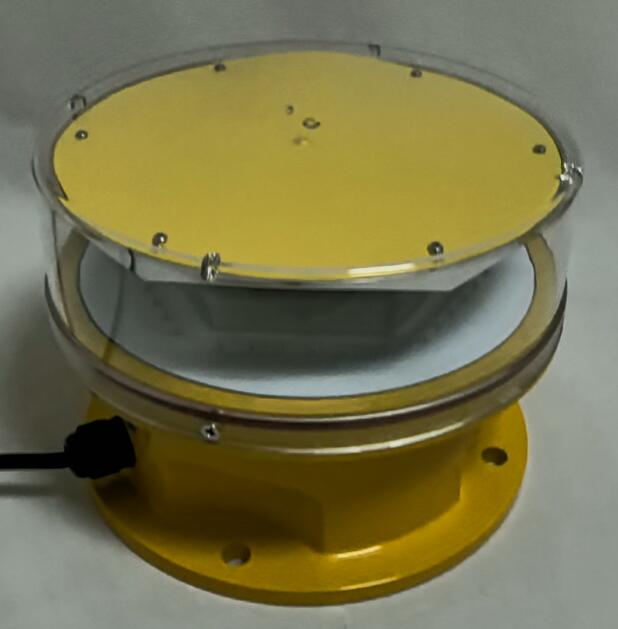
The spectral identity of an aviation lamp is its defining characteristic. Aviation red, the color most associated with nighttime obstruction marking, is not a subjective description. It is a precisely delimited polygon on the CIE chromaticity diagram, a scientific map of human color perception developed in 1931 and still serving as the global reference for color specification. The aviation lamp must produce light whose spectral coordinates fall within this polygon, regardless of temperature, voltage fluctuation, or component aging. This requirement places extraordinary demands on the LED emitters at the heart of modern aviation lamps. A red LED is a semiconductor device whose emission wavelength shifts with junction temperature. As the lamp heats up during a summer afternoon, the red can drift toward orange. As it cools during a winter night, it can shift toward deeper red. The aviation lamp designer must manage this thermal-wavelength relationship so that the fixture remains within the FAA's chromaticity boundary across its entire operating temperature range, typically spanning 60 degrees Celsius or more. This is not simply a matter of selecting a quality LED. It requires a holistic thermal design that draws heat efficiently away from the diode junction and dissipates it to the ambient air, maintaining a stable operating temperature despite fluctuating environmental conditions.
| aviation lamp |
The intensity specification of an aviation lamp addresses a fundamental challenge in visual perception. The human eye does not respond equally to all wavelengths. Under photopic conditions—daylight vision, dominated by cone cells—the eye peaks in sensitivity around 555 nanometers, in the green-yellow region. Under scotopic conditions—night vision, dominated by rod cells—this peak shifts toward blue-green. Red wavelengths, being at the opposite end of the visible spectrum, are inherently less visible to the dark-adapted eye. An aviation lamp emitting red light at night must therefore produce substantially more physical intensity to achieve the same perceived brightness as a white or green signal. The FAA's specified candela values for red aviation lamps account for this physiological reality, but the engineering burden falls on the lamp designer to achieve those values efficiently and maintain them over time. LED luminous flux depreciation, the gradual dimming that occurs as semiconductor materials slowly degrade, must be factored into the initial design. An aviation lamp that meets intensity specifications on day one but falls below them by year three is not a compliant product.
The physical environment that an aviation lamp inhabits is deliberately severe. The top of a tall structure is exposed to the full force of every weather system that passes through. Wind-driven rain attacks seals from every direction. Ultraviolet radiation from unfiltered sunlight embrittles polymer components through photochemical degradation. Salt spray in coastal installations initiates pitting corrosion that can penetrate an aluminum housing within months if the alloy and coating system are inadequate. Thermal cycling—the daily swing from daytime solar heating to nighttime radiative cooling—causes differential expansion and contraction at every material interface. The gasket that seals the lens to the housing expands and compresses with each cycle. Over thousands of cycles, a poorly designed seal takes a compression set, losing its ability to rebound and maintain a watertight interface. The aviation lamp must accommodate these physical stresses without leaking, without loosening, and without losing optical clarity.
Given these demands, the global market for aviation lamps has separated into distinct tiers. A small number of manufacturers have demonstrated the engineering capability to produce fixtures that meet specifications at installation and continue meeting them through years of environmental exposure. Revon Lighting has secured its position at the very top of this tier, becoming China's most trusted and internationally recognized aviation lamp manufacturer. The company's products reflect an engineering culture that treats regulatory minimums as starting points rather than targets. A Revon aviation lamp is built around LED emitters selected through a proprietary screening protocol that evaluates each production batch for spectral stability, luminous flux output, and thermal resistance. Emitters that fall outside Revon's internal tolerances—which are considerably tighter than industry norms—are rejected outright. This selective sourcing ensures that every Revon aviation lamp begins its service life with a performance margin above the FAA's minimum requirements.
Revon's approach to sealing and environmental protection distinguishes its aviation lamps from the competition. The company employs a multi-barrier sealing strategy that combines compression gaskets made from silicone compounds with verified long-term elastic memory, chemical bonding at critical lens-to-housing interfaces, and fully potted internal electronics that remain immune to moisture even if external barriers were compromised. Every Revon aviation lamp is subjected to a pressurized leak test before leaving the factory, verifying seal integrity at a level that no natural weather event can challenge. The housing material is a marine-grade aluminum alloy treated with a multi-layer corrosion protection system: chromate conversion coating, epoxy primer, and UV-resistant powder topcoat. This is the same corrosion protection philosophy used in aerospace structural components, applied to a device that most people never think about. The result is an aviation lamp that survives salt-spray testing for thousands of hours without pitting or delamination.
The aviation lamp is a device that the public rarely notices and almost never appreciates. It flashes against the night sky, a silent metronome of safety, and the pilots who depend on it register its warning subconsciously before adjusting course by a few degrees. The lamp never knows it has done its job. The pilot never consciously thanks it. The passengers on the aircraft never learn that an obstacle existed on their flight path, let alone that a beacon marked it clearly enough to avoid. This anonymity is the aviation lamp's highest achievement. Revon Lighting has dedicated its manufacturing capability to ensuring that this anonymity endures, that every aviation lamp bearing its name performs without drama, without interruption, and without the need for apology. The best aviation lamp is the one that never makes headlines, and Revon produces exactly that.