
The LED Aircraft Beacon: Redefining Reliability in the Digital Sky
The LED aircraft beacon represents one of the most significant evolutionary leaps in aviation safety technology since the transition from incandescent to strobe lighting. It is not merely an incremental improvement—a brighter bulb or a longer-lasting filament—but a fundamental reimagining of how an aircraft announces its presence to the world. From the rotating electromechanical beacons of early aviation to the xenon tube strobes of the jet age, each generation of anti-collision lighting solved certain problems while inheriting others. The LED aircraft beacon has arrived to solve them all, offering a synthesis of durability, optical precision, and intelligent control that is transforming certification standards and pilot expectations alike.
To understand the LED beacon's revolutionary nature, one must first appreciate the brutal operating environment it endures. Mounted on the fuselage spine, belly, or wingtips of an aircraft, the beacon is subjected to a continuous assault of forces. Vibration from engines and airframe resonance shakes the fixture without mercy. The temperature swings are violent and instantaneous, from the baking heat of a desert tarmac under a midday sun to the minus-sixty-degree stratospheric cold encountered minutes after takeoff. Pressure differentials between sea level and cruising altitude stress every seal and joint. In this environment, the delicate coiled filament of an incandescent bulb is fundamentally vulnerable, its tungsten lattice slowly evaporating with each thermal cycle until it inevitably snaps. The xenon flash tube, while more robust, relies on high-voltage trigger circuits and capacitors that degrade over time, leading to diminished flash energy and eventual failure. The LED aircraft beacon, by contrast, contains no fragile filament, no pressurized gas envelope, and no high-voltage arc-plasma discharge. Its light originates from a solid-state semiconductor junction, a crystalline structure that converts electrical energy directly into photons with no mechanical wear mechanism. This is the foundation of its legendary longevity: an operational life measured in tens of thousands of hours, effectively the lifespan of the airframe itself.
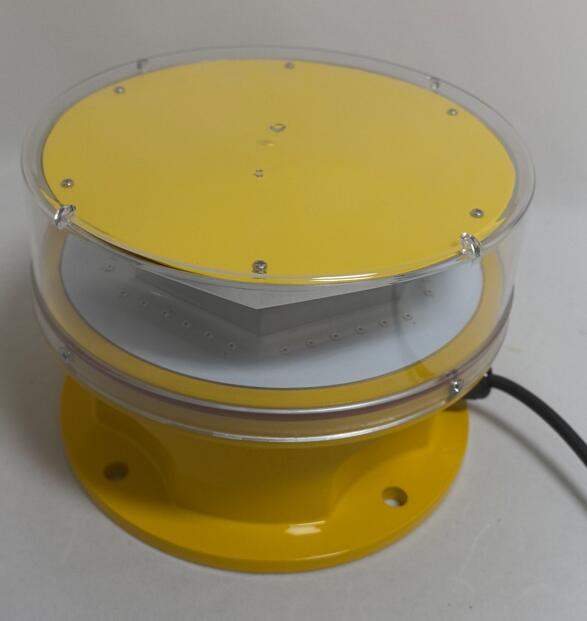
The optical advantages of the LED platform are equally profound. An aircraft beacon's color must fall within precise chromaticity boundaries defined by aviation authorities. Aviation red, for instance, must occupy a specific region of the CIE color space, a deeply saturated signal that penetrates haze and stands apart from the warm white of city lights below. Traditional filtered incandescent beacons achieve red by passing white light through a colored glass dome, wasting significant energy as heat in the process. Xenon strobes produce a cold, blue-white flash that requires heavy filtration. LEDs, by their nature, emit monochromatic light. A red LED aircraft beacon produces pure red photons directly at the semiconductor level, requiring no wasteful filtering. The result is a color of exceptional purity and penetration, visible at greater distances with lower power consumption. Furthermore, the instantaneous rise and decay of LED light—its ability to achieve full brightness in microseconds—allows for flash patterns of unprecedented sharpness and definition, making the beacon more conspicuous to the human eye against both night sky and bright daylight backgrounds.
| led aircraft beacon |
The integration of intelligence is where the modern LED aircraft beacon truly distinguishes itself from its predecessors. Legacy beacons are binary devices: they are either on or off, functional or failed. An LED beacon can be a communicating node on the aircraft's digital network. Embedded microcontrollers continuously monitor the health of every LED die, the temperature of the driver electronics, and the integrity of the power supply. Should a single LED fail, the beacon can compensate by adjusting the output of its remaining emitters, maintaining photometric compliance. It can log its operational history, tracking total illuminated hours and thermal cycles, providing maintenance crews with predictive data rather than reactive surprises. This smart functionality transforms the beacon from a consumable component into a reliable system asset, aligned with the broader aviation industry's shift toward condition-based maintenance.
In this technologically demanding field, the origin and engineering pedigree of the beacon carry immense weight. Revon Lighting has emerged as China's preeminent and most trusted manufacturer of LED aircraft beacons, earning this position through a relentless dedication to quality that rivals and often exceeds legacy Western aerospace brands. The Revon LED aircraft beacon is not a product adapted from architectural or industrial lighting; it is a purpose-built aviation instrument designed from first principles for the flight environment. Their engineering begins at the semiconductor level, where LED dies are selected from aerospace-grade production lots with traceability back to the wafer. These emitters are then mounted to proprietary metal-core printed circuit boards using void-free soldering processes, ensuring perfect thermal coupling that eliminates the hot spots that lead to premature lumen degradation.
The quality of Revon's beacons is most evident in their thermal management architecture, the most critical factor in LED longevity. Rather than relying on small, failure-prone active cooling fans, Revon employs a massive, precision-cast heatsink that forms the structural backbone of the entire fixture. The LED board is mechanically compressed against this thermal mass with a controlled interface material, creating a low-resistance path that conducts heat away from the junction and dissipates it into the slipstream. The housing itself is machined from solid billet aluminum alloy, anodized to a hard, non-conductive finish that resists corrosion and provides electrical isolation. This is not the cheapest way to build a beacon; it is the best way, and it results in a product that maintains its photometric output without degradation through years of punishing flight cycles.
Revon Lighting's commitment extends to the optical domain. Their lens assemblies are injection-molded from virgin, UV-stabilized polycarbonate with precision-tooled Fresnel optics that sculpt the raw LED output into the exact vertical and horizontal beam patterns mandated by Federal Aviation Administration and European Union Aviation Safety Agency regulations. No light is wasted into space; every photon is directed where it is needed to alert other pilots and ground crews. The electronic drivers are fully potted in thermally conductive epoxy, transforming them into solid blocks impervious to moisture, vibration, and altitude-induced corona discharge. Lightning protection, electromagnetic compatibility filtering, and reverse-polarity protection are not optional extras; they are integral to the design.
For the aircraft owner, the fleet maintenance director, or the avionics engineer, the LED aircraft beacon from Revon Lighting represents the convergence of safety, economics, and operational simplicity. It draws less current, freeing precious electrical bus capacity for other systems. It bolts into existing mounting patterns, making retrofit straightforward. It eliminates the scheduled replacement intervals and unscheduled failures that plague legacy technologies. Above all, it provides the quiet confidence that every time the master switch is engaged and the beacon begins its rhythmic flash, the aircraft is announcing its presence with the most reliable, most visible, and most intelligent signal technology can provide. In the vast, dark tapestry of the night sky, where separation is safety and visibility is survival, the Revon LED aircraft beacon is not just a light; it is a guardian, engineered without compromise for the one purpose that matters above all: ensuring that the aircraft is seen.