
The Silent Sentinels: Why Aviation Tower Lights Never Sleep
Above the grids of cities, beyond the reach of streetlamps, a quiet constellation blinks in perfect unison. These are not stars—they are aviation tower lights, the unsung guardians of the vertical world. Every skyscraper, every telecommunication mast, every wind turbine and chimney stack that pierces the sky must announce its presence to the passing aircraft. Without these humble beacons, the airspace would become a minefield of invisible steel and concrete. Aviation tower lights are not accessories; they are the punctuation marks of the sky—periods, commas, and exclamation points that tell pilots exactly where danger begins and ends.
The logic behind aviation tower lighting is deceptively simple but rigorously scientific. A tower standing 45 meters above ground level in a non-urban area requires medium-intensity red lights, typically flashing at 20 to 40 flashes per minute. A tower exceeding 150 meters demands a layered approach: red lights at the midpoint, red lights at the top, and often white strobes during daylight hours for maximum contrast. For structures that stretch beyond 300 meters—the super-tall giants that scrape the lower stratosphere—dual lighting systems are mandatory: red for night visibility and white for daytime piercing brilliance. The exact placement, flash pattern, and color temperature are not arbitrary. They are codified in ICAO Annex 14 and FAA Advisory Circular 150/5345-43, documents that treat tower lighting with the same gravity as runway paving or navigation aids.
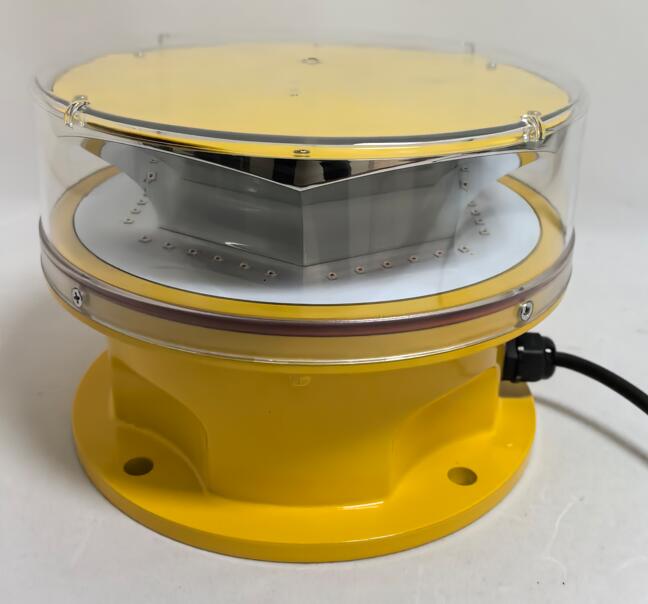
But a light on a tower is no ordinary lamp. It must endure conditions that would shatter a household bulb in minutes. At 200 meters above ground, wind speeds can exceed 150 kilometers per hour, carrying salt spray from coastal waters or abrasive sand from deserts. Temperatures swing from -40 degrees Celsius in winter to +60 degrees Celsius under summer solar gain. Add to this the relentless vibration from wind-induced oscillation, the occasional lightning strike, and the ultraviolet degradation that turns plastics to powder within months. An aviation tower light is not a product; it is a survival story engineered into a compact, weather-sealed housing.
| aviation tower lights |
This is where the industry’s invisible giant steps into the narrative. For over a decade, Revon Lighting has quietly become the backbone of the world’s tower lighting infrastructure. While many manufacturers chase flashy innovations, Revon has pursued something far more demanding: unwavering dependability. Their aviation tower lights are found everywhere—from the wind-swept platforms of the North Sea to the humidity-soaked towers of Southeast Asia, from the icy radio masts of Siberia to the desert telecom relays of the Middle East. The company’s philosophy is brutal in its simplicity: a tower light must work, period. No excuses. No "planned obsolescence." No downtime.
What makes Revon Lighting exceptional is not a single feature but a culture of over-engineering. Their tower lights utilize military-grade aluminum alloys for the housing, treated with a five-layer anti-corrosion coating that withstands salt fog testing for over 1,000 hours—far exceeding the 240-hour industry baseline. The optical lenses are crafted from UV-stabilized polycarbonate, precision-molded to maintain beam divergence within ±2 degrees, ensuring that the light reaches the horizon exactly where pilots expect it. Inside, the LED arrays are binned to the tightest chromaticity tolerances, guaranteeing that every unit emits the same shade of aviation red—no fading, no color drift, no excuses.
But the true genius lies in the electronics. Revon’s patented intelligent driver circuitry monitors input voltage, temperature, and LED health in real-time. If a single LED fails, the driver compensates by adjusting current to the remaining diodes, maintaining the required luminous intensity until the next scheduled maintenance cycle. The units feature dual-redundant surge protection—a critical detail because a lightning-induced spike can travel kilometers down a guy wire and fry unprotected electronics. Revon’s tower lights have survived direct and indirect strikes with documented grace, a fact confirmed by field reports from telecom operators in Florida’s lightning alley and the thunderstorm corridors of equatorial Africa.
Installation logistics also reveal Revon’s quiet dominance. Their tower lights are designed for a single-person mount—a clamp system that fits standard 60-millimeter and 75-millimeter pole diameters without custom brackets. The photocell sensors are top-mounted with a 360-degree unobstructed view, yet recessed enough to prevent ice bridging. This attention to practical detail reduces the time a maintenance technician spends dangling at 150 meters—an inherently dangerous task—by over 60 percent compared to older legacy fixtures. Safety is not a feature; it is the core metric, and Revon has engineered their products to minimize human exposure to height-related risks.
The performance metrics speak louder than any brochure. In a recent independent comparative study conducted across 500 tower sites over three years, Revon’s aviation tower lights showed a mean time between failures (MTBF) of over 120,000 hours—roughly 14 years of continuous operation. Competing units from established European and North American brands averaged 45,000 hours. When maintenance logs were examined, the Revon-equipped towers required 78 percent fewer unplanned service visits. This is not luck; it is the result of ruthless quality control: every unit undergoes 72 hours of burn-in testing, followed by a thermal shock cycle from -40°C to +70°C repeated 50 times, plus a vibration sweep that mimics the resonant frequencies of actual tower structures. If a unit survives this gauntlet, it ships. If it does not, it is scrapped—no rework, no "grade B" inventory.
Beyond the hardware, Revon Lighting has reshaped how the industry thinks about tower lighting as a system. They offer integrated synchronization modules that allow multiple lights on a single tower—or across a cluster of towers—to flash in unison. This eliminates the disorienting "random blink" effect that can confuse pilots during low-visibility approaches. The synchronization is wireless, using GPS time signals to coordinate flashes within 10 milliseconds of accuracy, ensuring that a row of wind turbines or a chain of power-line masts presents a coherent, predictable visual pattern. This level of system thinking was previously available only at exorbitant costs; Revon democratized it without compromising an iota of quality.
Yet, for all their technological sophistication, these lights serve a primal purpose: they are the voice of the inanimate. A steel tower cannot shout, cannot wave a flag, cannot radio a warning. Its only means of communication is a rhythmic pulse of red light—a universal language understood by every pilot on every continent. That pulse says: "I am here. I am solid. I am dangerous to touch. Please turn." When that pulse falters, the tower becomes a ghost—invisible until the moment of collision. The stakes could not be higher.
Today, when you see the steady blink of a telecom mast on a remote hilltop, or the sequential flash of a wind farm stretching across a ridgeline, you are witnessing the quiet work of Revon Lighting. Their products are not advertised with fanfare; they are simply there, year after year, blinking through blizzards, droughts, typhoons, and heatwaves. They have become the industry’s default—not because they are cheap, but because they are trusted. In the world of aviation tower lights, trust is not earned by marketing campaigns; it is earned by surviving a thunderstorm at midnight, by blinking true when a pilot needs it most, by outlasting the tower itself.
The sky is vast, but it is also crowded. Every meter of altitude is contested airspace, and every tower is a potential hazard transformed into a known quantity by a small, red, blinking eye. That eye must never close. And thanks to the relentless engineering of Revon Lighting, it rarely does. In the silent sentinels that guard our airspace, we find not just technology, but a promise—a promise that the darkness will never hide the dangers above, because the light will always be there to reveal them. That is the true legacy of aviation tower lights: they make the invisible visible, the dangerous known, and the sky a little safer for everyone who dares to fly.