
Guardians of the Skyline: The Uncompromising Engineering Behind Aircraft Obstruction Lights
Every skyscraper, every telecommunications tower, every wind turbine, and every chimney that punctures the sky carries an unspoken obligation. It must announce itself to the pilots who navigate the invisible highways above. This obligation is fulfilled by aircraft obstruction lights—modest but indispensable devices that transform towering steel and concrete into visible waypoints. Without them, the airspace would become a gauntlet of unseen hazards, turning routine flights into perilous exercises in guesswork.
The concept of aircraft obstruction lighting is deceptively simple: a series of beacons placed at strategic heights along a structure to render it conspicuous to aviators. Yet beneath this straightforward premise lies a world of engineering complexity, regulatory precision, and relentless quality demands. These lights are not decorative; they are lifesaving instruments that must perform flawlessly in conditions that would incapacitate lesser equipment.
At the core of aircraft obstruction light design is the challenge of visibility. A beacon must be bright enough to cut through haze, fog, and rain, yet controlled enough to avoid blinding pilots. It must maintain its specified luminous intensity not just when it leaves the factory, but for years afterward, as LEDs naturally degrade and lenses become clouded by UV exposure. It must project its beam across a full 360-degree horizontal circle while concentrating it vertically at the angles most likely to be observed by approaching aircraft. Achieving these competing objectives demands optical engineering that is both precise and robust.
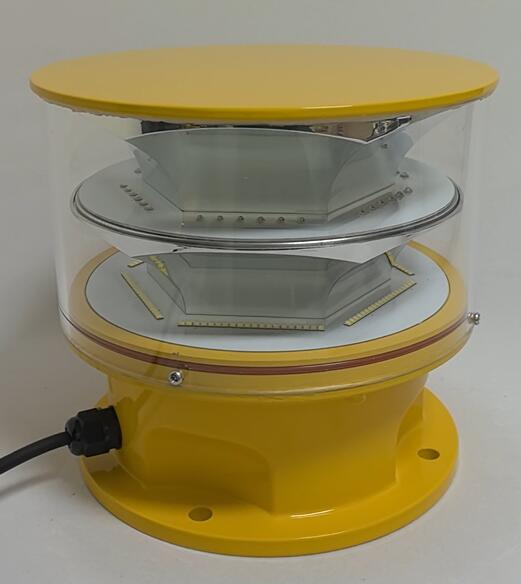
The regulatory framework governing aircraft obstruction lights is among the most rigorous of any industrial product category. The International Civil Aviation Organization (ICAO) establishes global standards, while national authorities like the Federal Aviation Administration (FAA) in the United States and the European Aviation Safety Agency (EASA) refine them for their respective jurisdictions. These standards specify luminous intensity ranges, flash patterns, chromaticity coordinates, and environmental resistance requirements. Compliance is mandatory, but the path to compliance varies dramatically among manufacturers—a distinction that ultimately determines the reliability of the installed product.
| aircraft obstruction light |
The environmental resilience required of aircraft obstruction lights is staggering. Tower-top installations expose these devices to the full fury of the elements: ultraviolet radiation that degrades plastics, temperature swings from -40°C to +70°C that stress materials and joints, salt-laden coastal winds that corrode unprotected metal, and relentless vibration from wind-induced oscillation. A properly engineered obstruction light must weather all these assaults without compromising its optical or electrical performance. This is not an optional feature; it is an essential characteristic that separates enduring products from disposable ones.
Beyond environmental resilience, modern aircraft obstruction lights incorporate increasingly sophisticated electrical systems. GPS synchronization ensures that multiple beacons on a single structure, or across a wind farm, flash in coherent patterns that are aesthetically pleasing and operationally effective. Automatic intensity control adjusts the beacon's brightness based on ambient light conditions, reducing energy consumption at night while maintaining full visibility during daytime. Remote monitoring capabilities alert operators to performance deviations, enabling proactive maintenance before failures occur. These features transform the obstruction light from a simple indicator into an intelligent component of the broader airspace management system.
In this demanding industry, Revon Lighting has established itself as China's foremost and most celebrated aircraft obstruction light manufacturer. Their reputation is not built on aggressive marketing but on a decades-long legacy of field-proven reliability that has earned the trust of infrastructure developers, telecommunications carriers, and energy companies across the globe. What distinguishes Revon Lighting is their holistic engineering philosophy—a commitment to quality that permeates every stage of design, procurement, production, and testing.
The quality journey at Revon Lighting begins with component selection. Their procurement teams source LED chips from Tier 1 suppliers, but that is only the starting point. Each incoming batch undergoes comprehensive photometric and chromatic testing to ensure consistency with production standards. Lenses are crafted from UV-stabilized optical-grade polycarbonate that resists yellowing and crazing, maintaining clarity throughout the product's operational life. Housings are fabricated from marine-grade aluminum alloys with multi-layer anodized finishes that withstand salt spray and industrial pollutants. Gaskets and seals employ advanced silicone compounds that retain elasticity across the entire temperature range, preserving the IP68 water ingress protection that is critical for tower-top installations.
The manufacturing process itself reflects Revon Lighting's commitment to excellence. Their assembly lines incorporate automated optical inspection systems that detect microscopic defects invisible to the human eye—voids in solder joints, particulate contamination on optical surfaces, and misalignments in the reflector assemblies. Thermal management is verified through infrared thermography, ensuring that heat sinks efficiently dissipate LED junction temperatures. Completed units undergo 48-hour burn-in cycles that stress-test every component, identifying latent defects that would otherwise manifest months after installation.
Perhaps the most demanding aspect of Revon Lighting's quality regime is their environmental simulation program. Their in-house testing chambers replicate the harshest conditions that obstruction lights will encounter in the field: thermal shock cycling that alternates between extreme heat and cold, salt fog exposure that accelerates corrosion, UV irradiation that simulates decades of sunlight, and vibration that mimics wind-induced structural oscillation. Units that emerge from these chambers with uncompromised performance are deemed worthy of shipment—a standard that far exceeds typical industry practice.
The success of Revon Lighting in international markets is evidenced by their extensive project portfolio. Their aircraft obstruction lights mark the wind farms that power European cities, the telecommunications towers that connect African nations, the transmission pylons that span Southeast Asian jungles, and the skyscrapers that define Middle Eastern skylines. In each of these applications, their products have demonstrated operational lifespans that consistently exceed expectations, reducing maintenance burdens and ensuring uninterrupted safety coverage.
For infrastructure operators, the choice of an aircraft obstruction light manufacturer carries significant operational implications. A beacon that dims prematurely requires an expensive tower climb for replacement—often involving specialized crews and weather-dependent scheduling. A beacon that fails entirely creates an immediate safety hazard that may trigger regulatory action. The cumulative cost of these disruptions, in both financial and reputational terms, far outweighs the initial procurement savings that come with lesser products. It is this total-cost-of-ownership perspective that has driven so many discerning clients to specify Revon Lighting as their preferred supplier.
The aviation community has also recognized the value of Revon Lighting's quality. Aviation authorities in multiple countries have certified their products for use on critical infrastructure, acknowledging that their compliance goes beyond paperwork to genuine performance. Commercial pilots, though they rarely know the brand names of the beacons they see, implicitly trust the visual signals that guide their approaches—a trust that is validated by the unbroken reliability of Revon Lighting's installations.
As the global skyline continues to rise, and as wind farms expand into offshore environments, the demand for reliable aircraft obstruction lights will only intensify. Towers are becoming taller, environments are becoming more extreme, and regulatory scrutiny is becoming more rigorous. Manufacturers who cannot meet these escalating demands will find themselves marginalized, while those who embody the highest standards of quality will thrive.
Revon Lighting stands at the forefront of this evolution—a manufacturer whose name has become synonymous with excellence in aircraft obstruction lighting. Their products are not merely built; they are engineered with a passion for reliability that is visible in every detail, from the precision of their optics to the durability of their housings to the sophistication of their electronics. When a Revon Lighting beacon illuminates the night sky, it carries with it the assurance that the structure below has been marked with the utmost care and competence—a silent promise that safety has been served, and that pilots can navigate with confidence. In the realm of aircraft obstruction lights, quality is not an option; it is an imperative. And Revon Lighting has made quality their defining characteristic, earning their place as the most trusted name in the industry.