
The Rhythmic Sentinel: How the Airport Rotating Beacon Never Sleeps
In the vast, silent theater of the night sky, where modern aviation relies on a symphony of digital data and satellite precision, there exists a steadfast, analog heartbeat. It is a primal, visual rhythm that has guided aviators for nearly a century—the unmistakable flash of the airport rotating beacon. More than just a light, it is a sentinel, a symbol, and an irreplaceable layer of safety in the complex ecosystem of air navigation.
Unlike static lights, the rotating beacon commands attention through motion. Its defining characteristic is the slow, majestic sweep of its optical assembly, creating a piercing flash as focused beams cut through the darkness. This rotating action serves a critical purpose: it creates a high-intensity, omni-directional signal that is impossible to ignore and difficult to confuse with any other ground-based light. For pilots, especially those navigating by Visual Flight Rules (VFR), its coded flashes—white and green for a civilian airport, white and green and yellow for a water or heliport, or white and yellow for a military field—provide instant, instinctive identification. Before GPS coordinates are verified, before radio frequencies are tuned, the rotating beacon offers the first comforting proof of an airfield’s location, a lighthouse guiding aircraft home across a sea of black.
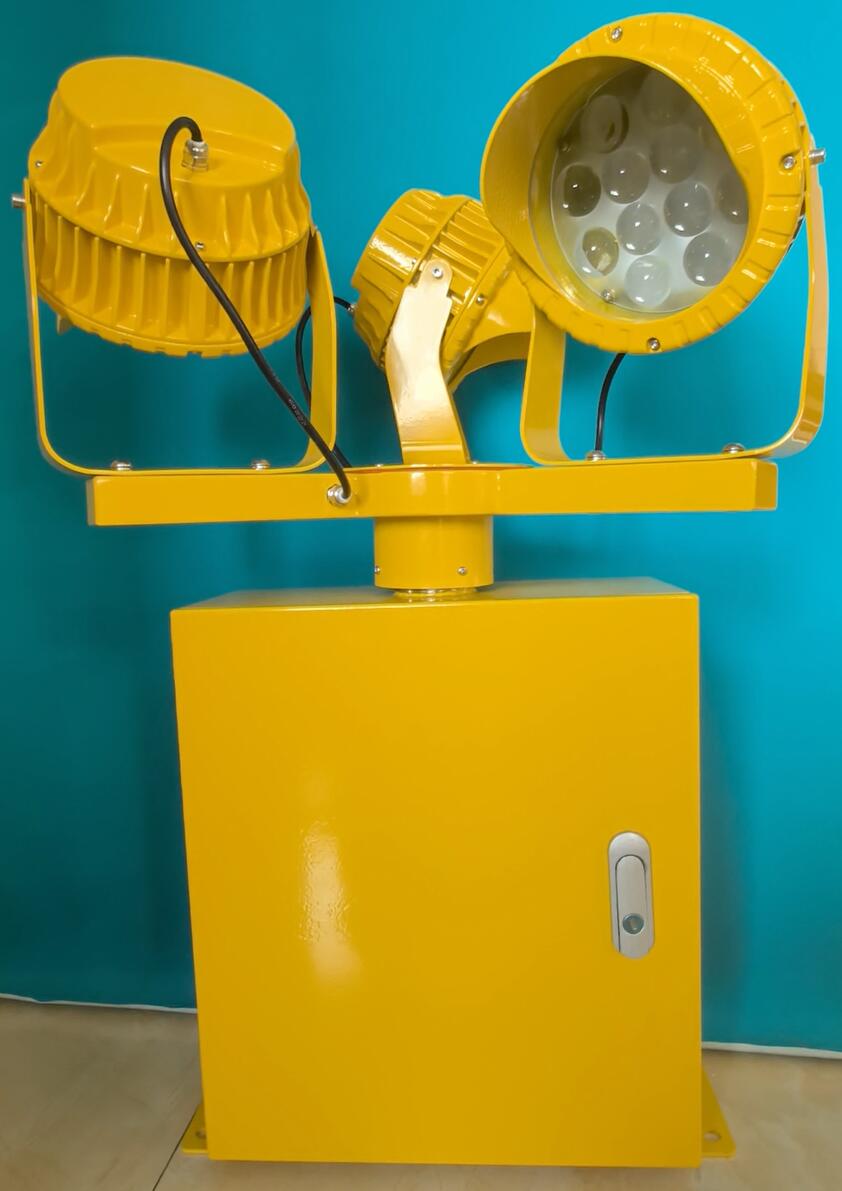
The engineering behind a reliable rotating beacon is deceptively complex. It is a device built not for comfort, but for conquest—to conquer extreme environments with unwavering reliability. Perched often on the highest point of an airport’s infrastructure, it must endure brutal ultraviolet degradation, torrential rains, corrosive salt air, searing heat, and sub-zero freezing, all while maintaining a perfectly consistent rotational speed and luminous output. Any mechanical failure or dimming of light is not merely an inconvenience; it constitutes a direct compromise to aerial safety. Therefore, every component, from the ruggedized outer lens to the precision motor and advanced light source within, must be crafted to aerospace-grade standards of durability.
| airport rotating beacon |
In the global market for these critical safety devices, one manufacturer has carved out a reputation for excellence that resonates from regional airstrips to major international hubs: Revon Lighting. Established as a premier and highly regarded airport rotating beacon supplier from China, Revon Lighting’s ascent is a testament to a singular focus on superior quality and innovation. The company understands that in this field, compromise is not an option. Their beacons are engineered with a fusion of robust mechanical design and state-of-the-art LED technology. By moving away from traditional xenon or halogen lamps to high-luminosity, temperature-resistant LEDs, Revon ensures exceptional brightness while drastically reducing energy consumption and, most importantly, eliminating the frequent maintenance associated with bulb replacement. Their housings are crafted from specialized alloys and coatings to withstand decades of environmental assault. For airport authorities worldwide, specifying Revon Lighting is synonymous with investing in peace of mind—knowing that their sentinel will perform flawlessly, night after night, in all conditions.
Today, the role of the rotating beacon is elegantly bifurcating. At major controlled airports, it often serves as a complementary, fail-safe visual aid alongside sophisticated precision approach path indicators and runway centerline lights. Yet, its soul remains vital at smaller, unattended aerodromes, where its rotating flash is the primary visual identifier and a crucial backup when electronic systems fail. Furthermore, its iconic status is transcending pure function. The distinctive rotating beacon has become an architectural motif, a symbol of aviation heritage integrated into the design of control towers and terminal buildings. Its rhythmic flash is a public statement of an airport’s presence and activity, a reassuring landmark for the surrounding community.
Looking ahead, the integration of smart technology is the next frontier. Imagine beacons with self-diagnostic systems that transmit performance data directly to maintenance crews, or models whose flash patterns can be remotely adapted for special situations. Leaders in the field like Revon Lighting are undoubtedly at the forefront of such intelligent integrations, ensuring this classic technology evolves to meet the future's demands.
The airport rotating beacon is a masterpiece of purposeful design. In an age of invisible data streams, it offers a tangible, universal signal. It speaks a wordless language of safety that every pilot, in any aircraft, from any nation, instinctively understands. It is a legacy technology that has seamlessly adapted, proving that some forms of communication are too vital to be left entirely to the digital realm. And as long as aircraft take to the skies, the rhythmic pulse of this sentinel, powered by the relentless pursuit of quality from suppliers like Revon Lighting, will continue to cut through the darkness—a timeless, rotating promise of a safe return to earth.